The Transferable Skills Trap - Jobseeker Basics III

Greg Wyatt • October 21, 2025

The following is Chapter 4 in A Career Breakdown Kit, my guide for improving your odds in a VUCA jobs market.


Fundamentally it's a chapter about selling yourself, and moving from features to benefits to how it matters.


Similar to the advice I give to employers in how and why they should move from generic copy+paste job adverts to specific, representative content that shows context and has meaning.


The same generic adverts you tailor your CV towards (a chapter for another time).


Put it this way -


Do you buy Pizza because it contains flour, yeast, dough, salt and water?

Do you buy it for the toppings?

Or do you buy it because of the way it makes you feel as a regular buyer or someone attracted to its packaging?


My favourite pizza has a bite, a sizzle, the richness juiciness of its sauce and how it combines with the stretchy delight of mozzarella. Oh, and that spicy kick from the Jalapenos!


Transferable skills are your dough - the basic ingredients - important in the right place, but must be defined in the right way to have meaning for your ideal readers.


Chapter 4 - The transferable skills trap


Maybe your top ten looks like this:


  • Strategic Thinking
  • Leadership
  • Communication
  • Problem-Solving
  • Decision-Making
  • Organisation
  • Analytical Skills
  • Project Management
  • Change Management
  • Relationship Building


If you’re a COO, that is.


If you’re in a different field, your list may look a little different - why not ask a large language model? Gemini came up with the one above.


I expect the results would be similar for an HR Director, with a little people strategy, employee relations and EVP development thrown in for good measure.


Here’s the rub - if these skills are in your top 10 list of transferable skills, they are likely in the top 10 list of your competition’s transferable skills.


And if everyone has the same skills, none of these skills stand out.


If transferable skills are your unique selling point… how are they unique?


The problem doubles down.


If, in our days of generic advertising, a company is looking for a COO or an HR Director, their essential required skills can often include these transferable skills.


Can you communicate at all levels with strategic thinking, fostering an innovative culture?


Me too!


We all ‘know’ that a customised CV is the way to go. (Is it though? Check out Part Three for my answers.)


What exactly are you customising against, if your custom skills are the same as every other applicant who applies to this advert?


This is the transferable skills trap.


Skills that in real life serve you well and are valuable in any context. Yet skills that are common enough they work against you, when you declare them your strength.


What can we do?


Move from transferable to applicable.


Applicable skills are precisely the same skills as transferable skills, with two differences:


  • Direction
  • Definition


The direction of any applicable skills is that of the employer.


How does your skill apply in their domain?


The definition of any applicable skill is the context in which you have applied them successfully. This can be synonymous skills, tools, processes, software, etc.


If the direction and definition don’t reflect each other, you may not be an ideal candidate.


Should you even apply?


And if they do reflect each other, the onus is on you to show explicitly how your skills work in the employer’s context.


In an ideal world employer hiring processes are skilled and knowledgeable.


In practice, you should assume the weakest link in their hiring process is the gatekeeper - an administrator, a recruiter, an HR assistant.

Maybe they’re lazy, maybe incompetent, maybe swamped, maybe inexperienced.


It doesn’t matter - a weak part of a hiring process doesn’t necessarily mean employment is unsuitable but can prevent you from being considered.


Help us do our jobs by showing how your skills apply, and we may see you as a suitable candidate.


With the benefit that this helps skilled recruiters too.


What is context?


This is the relevant background that adds sufficient substance to an assertion.


So, you’re a COO?


Are you a COO within a £2m bootstrapped start-up that’s achieving profitability?


Do you work in a multinational charity streamlining your operations to save money?


Or are you a safe pair of hands to keep the ship steady in your £30m family-owned manufacturing company with 120 employees?


These three COOs may well have the same transferable skills, and might each be brilliant, but their contexts are more important than their job title in assessing suitability.


Going further.


The ugly brother of transferable skills is responsibilities and experience.


In the same way adverts copy-paste job descriptions, how many CVs do the same under each job title in a CV?


There may be hundreds of applications each sharing the same explanations.


Fortunately, you can apply direction and definition here too, by showing impact, by showing your achievements (with numbers and context), and by showing how you can help.


These principles help you move from being a <job title> with a dry set of responsibilities and experiences.

To someone who shows how they can help, how you can solve problems, and how you can heal the pain of the people who might employ you.


It’s the same as moving from features to benefits in sales.


Features are what you do. Benefits are how the customer’s life is improved.


Transferable skills are highly valuable to your next employer. You should be proud of them.


Unless they are specific and relevant to the roles you apply for, they can get in your way.


If you can gain insight into what your potential employer needs, and show how you may solve their problems, your odds will improve.


The frustrating caveat to this is that sometimes you are only given a generic advert to try and glean this from.


If you can’t gain insight, is there any point in showing applicability by tailoring?


Apart from using their terminology (such as if they say Continuous Improvement, and you’re a Six Sigma Black Belt), my answer is no.

Instead, default to a good enough CV. One which plays to your strengths by showing how your skills apply through tools, process, context and achievements.


Apply with what you have, follow their instructions and diarise a follow-up. Then move on.


Treat transactional generic adverts transactionally and worry more about the ones that speak to you personally.


Don’t rely on transferable skills in the hope that others will see how they apply.


Help us do our jobs and see you as a great candidate by showing how your skills apply.


This won’t guarantee interviews. It will improve your odds.


Showing applicability is a strong gain for every aspect of your job search.
By Greg Wyatt April 30, 2026
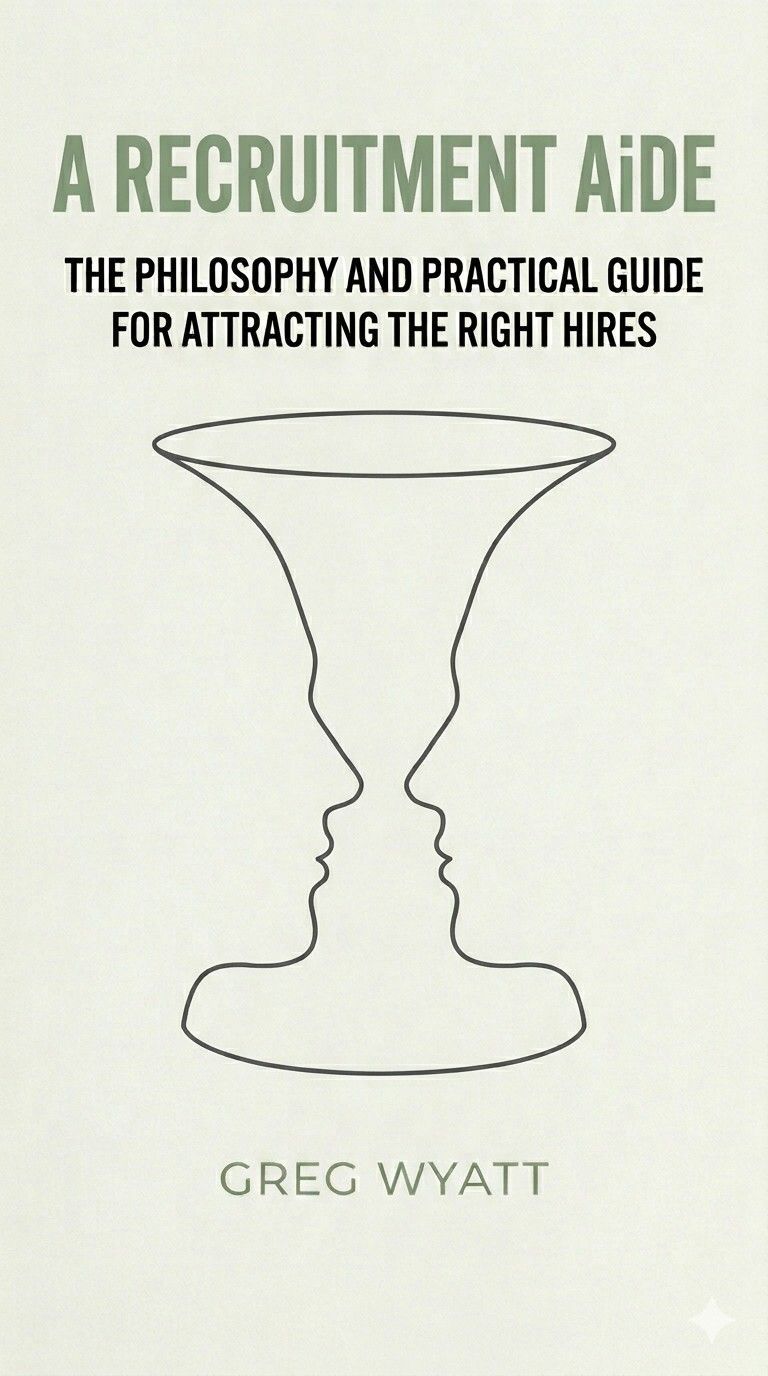
I'm thrilled to announce the publication of A Recruitment AiDE. A guide, philosophy and discipline for effective key hire recruitment. The timing’s perfect, given the deluge of AI content that floods our feeds. Imagine how these similarly produced generic adverts land with people you want to talk to. "We're thrilled to announce we want, we need, here’s our shopping list, why aren’t you responding and oh what’s this flood of AI CVs?" It doesn’t have to be this way. This has taken twenty-five years of hard graft - talking to job seekers, researching the market and recruitment practice, learning about candidate resentment, problem awareness, marketing, copywriting, and the psychology of what moves people. With the evidence that backs this up. The result is something that may make you rethink your approach to recruitment. That will improve the number of qualified candidates, while reducing the total number of applications. It's too early to prove, but my expectation is this will reduce the number of AI CVs too, given there is less for AI to grab when you speak to professional identity. You’ll have to be bold, go against the grain, do something that feels counterintuitive, especially if someone has their hand on your shoulder saying "This isn't the company style!" But then, what does it take to stand out from the crowd? And if you really want to attract the best people, shouldn’t your first step be focused on them, and not you? Kindle version out now. Here's the link: https://amzn.eu/d/03idlAVM.  Paperback in two weeks. If you don’t like Evilcorp, let me know and we can work something out.
By Greg Wyatt April 27, 2026
What follows is Chapter 40 of A Career Breakdown Kit , and part two of a three part series on Personal Branding. Except it isn't. There are various definitions I revolt against, with good reason, in a job search. Personal branding, hidden jobs markets, ATS compliance, and all the others. Terms that seem to hide secret wins, not replicable steps, especially when hidden behind a paywall. I call it the title that's expected because of the questions job seekers ask me. You may recall my article on the Hidden Jobs Market breaks it apart and rebuilds it into a cohesive multichannel marketing strategy that allows you to access the whole of your jobs market. And so it is with my personal branding series. This isn't about your brand. Or even about your reputation. It's about pushing content that starts conversations with relevant people - such as peers, former colleagues, recruiters with a vested interest in these content areas, and even people that can put you closer to a job. Not forgetting fellow job seekers you can share experiences with - as long as you don't dwell on the negative. And it's also about writing in a way that is both true to you and your profession - because conversation has to follow in the same voice as you write, and should support your work, when in work. It's a strategy and philosophy that mirrors earlier chapters on networking, doorknocking, getting found and converting interest. It isn't about writing credible statements in a content savvy way that shares unprovable anecdotes, hacks that lack substance, and where a funnel means more than a lesson. That way is the way of social media marketing - this is about conversations that matter. 40 - Content strategy and philosophy While a personal brand might be the goal, your content strategy should be the priority. It can be applied even if you don’t like the idea of branding. Much is made about LinkedIn’s algorithm and how you need to do this that and the other to get engagement. You can look at it differently, ignoring the algorithm on the whole, and still achieve much the same. These are the outcomes I aim for and see when writing content: Start conversations Help others Sharpen and spark ideas Raise awareness and trust Have a laugh and a chat I’ve gained friends I’ve never spoken to and friendly acquaintances I only know through ‘comments.’ As well as paying clients who have benefitted from my service. Just as importantly, I have more credibility with candidates who place weight on LinkedIn content. Content makes it easier for me to start conversations. It’s important for me that I either enjoy the content and its consequences or find it fulfilling. I don’t talk openly about my personal life, family or challenges. Something I agreed with my wife when I started publishing content. Instead, I show all of myself in my words - quirks and all. So that if we ever speak in real life, there isn’t much of a disconnect. Start with other people’s content Find content writers who inspire you and use them as a catalyst for your own words. There are two ways to do this. Firstly, if you’re thinking about writing on LinkedIn, you are presumably already reading content. What inspires you? What do you enjoy reading? Which authors resonate with your career, your values, your goals and the problems you solve? When you read their content, do you engage and comment? Do you connect with them? Do you ask them who they recommend as writers in your field? Secondly, look within. What do you want to be known for in your career? Maybe it’s procurement or your CIPD membership. React or agile. 5 Whys or Gemba. If these are areas that interest you, use the LinkedIn search bar to find posts on these topics. Now filter the results by ‘Posts’ and ‘Sort by’ latest. Read through the results both for posts that interest you and those that have high engagement (less likely on a niche topic). When you’ve found inspiring content, what next ? One first step in content creation is to respond to these posts with your own ideas. Less ‘Agree’ and more how you might respond in a real-life conversation on this topic. Commenting on other people’s posts is a good way to find your voice, particularly if the conversation continues. Like any skill, writing takes practice, and comments are a low-friction way of developing your tone. If a comment sparks interest from other readers, it can be a concept to build on as a post in its own right. The other benefit of this kind of niche content is that those who engage are likely to have similar interests to you. Make sure to read other comments and see if there are more conversations to be had. The comments you build with them can be the start of a mutually beneficial relationship. Check out their profiles - do their interests and values reflect yours? These are people to connect with, then DM to continue the conversation. Check out their posting history, which will be available on their profile - there may well be a lot of interesting content to absorb. With conversation comes content. Ideas and discussion that grow are an effective way to share your voice. Here’s a suggestion for how you can do this in practice: Look for 5 posts daily that interest you professionally - manually, using a search, or checking what your valuable connections are up to Engage and comment on each Check out new relevant profiles - connect and follow their content On each post, look at who is engaging and respond naturally Try to connect with 5 new relevant people from these interactions Perhaps follow up with a message Take note of the most interesting conversations and at the end of the week pick at least one to inspire your own posts You don’t need to publish them if you aren’t comfortable - save for later if not I’d avoid the viral content that combines relevance + relatability + entitlement + readability. These writers are more interested in engagement numbers than your specific interest. You can see the truth of their words in how they respond in the comments sections. From a marketing perspective, different types of content have different places in your lead generation: Awareness Interest Consideration Evaluation Purchase Each post, comment, DM and real-life conversation can relate to these steps and support your goals, even if you aren’t treating these as a marketing activity. Time and time again There’s a lot of investigation into optimal times to post. It’s more important that you are available to reply attentively in the first hour. The course of a post is often dictated by the performance during this time. I actively reply to comments for around an hour a day with LinkedIn on in the background of other work. How much time can you set aside per week and per day for content? Even if you only write a couple of posts a week, this will probably take a couple of hours. You can expect low performance initially, with some exceptions, as it takes time to build inertia. Set aside a sustainable amount of time each week and commit to it over a period - try for 10-12 weeks and track how things have developed. You may find it becomes an enjoyable task. Try not to get distracted by engagement for its own sake and keep your goals in mind. Types of content to try Engagement on LinkedIn is built primarily on relevance and relatability. Even ragebait, given it drives strong feeling. You can write a 100% relatable post that everyone takes relevance from and see massive engagement. Though that engagement may not serve your goals. Or you can write a post that is 100% relevant to the problems you solve in your career, and the people who will find it relevant are from a small niche facing the same problems. This is why a photo of you with your dog will fly, while a carefully thought out post about the optimisation of widgets in a byzantine setting will appear to be shouting into a void. Or you can blend the two through storytelling, pivoting observations into business content, and copywriting formulae like AIDA (attention interest desire action) and PAS (problem agitation solution). Everyone will have different forms of content that will be effective for them. What do you want your ideal readers to experience? What would ‘you five years ago’ would find helpful? Do you want readers to see you as a credible expert? Someone who is authentically vulnerable? Your warts and all personality? Someone who stands out in a sea of competition? Someone who is thought-provoking, helpful, or altruistic? The answers are much the same if you posed these questions of interviewing. This is no coincidence, given your message should be consistently delivered no matter where it is received. With that in mind, here are some content ideas you can try: How you might solve a problem specific to your industry Stories from your everyday life The challenges in your job search Observations on a news story and how it relates to your work A flair post highlighting your availability Asking for thoughts on an idea you are interested in Sharing insight you find fascinating, whether that’s films, video games, science or sport Stories from your career where you can show growth (everyone loves a hero’s journey) Business frameworks, processes and techniques you find useful - Pomodoro Technique, scientific method, STAR, what do you use? Equipment you use for work Developments in your workplace and culture Thoughts on content you find inspiring Memes, humour, satire Google content ideas for LinkedIn or ask ChatGPT, Claude and others. I wouldn’t use AI to write articles. I do use them for ideation and to sense check. ‘Write me a post for LinkedIn that shows the link between Tesla cars and how to develop an HR strategy.’ The vulnerability of writing You can be a content creator without ever publishing a post if you continue conversations through comments, connections, DMs and real-life. This avoids sticking your head above the parapets and is low risk, but misses the gain of publishing your own content. I know that some people are held back for fear of failure. I can tell you that clicking ‘send’ is always a high point of anxiety for me in sending newsletters. Imagine how I felt when I clicked Publish for this book. What’s the worst that can happen with a carefully thought-out post? Tumbleweed? If no one reads it, you can always post it again another time. Disagreement? Loads of people disagree on my posts - you’ll see from my comments that I am always constructive in my dialogue and typically this supports the intent of my post. Everyone has an opinion and they are welcome to theirs - as long as it’s constructive, there is always a learning opportunity. Trolls? These people exist and will at some point rear their ugly heads. I imagine them naked on the Underground, which takes the sting out of their vitriol. I’m sure it’s their unhappiness that drives their behaviour. Marriage requests? Unfortunately, dubious and toxic behaviour isn’t uncommon. Don’t be afraid to block and report if you receive harmful messages. As long as you are constructive in what you write and you work to build a conversation, it’s unlikely anything bad will happen. You will open yourself up to the opportunity of new relevant people starting conversations with you: hiring managers, recruiters, peers, fellow job seekers, and friendly strangers. Weight and depth of opinion A couple of years ago, I had a message from an out-of-work Sales Director asking for some feedback. He’d shot a video for LinkedIn where he talked about why he should be snapped up and received a lot of praise for the post. However, he was confused because a CEO he trusts told him it was poor and made him look boring. He knew I’d give him unvarnished feedback, which was what he needed to find some clarity on what had happened. Truthfully, the CEO was correct. What had happened? All of the positive engagement was from fellow job seekers and people who wanted to support him. That he’d done it was praiseworthy in itself and was rightly celebrated, rather than the quality of what he had produced. None of them had hiring authority or were in a career similar to someone who would be his line manager. The video didn’t show him how he comes across in person either. While the positive feedback was fantastic for validation, his video worked against him. What might happen if a hiring process thought his video was boring when the role being recruited for has persuasion as a key requirement? I’m pleased to say his redo was excellent, showing off his charisma while delivering the same message. Who can you rely on to be this CEO for you in your career? Why you should start now, even if you don’t see any benefit for months. Starting cold on LinkedIn can take time to get traction. When your first post bombs you might never think to do a second. Going in with the expectation of little impact for the first three to six months is healthy in making a sustainable habit. If you’re out of work though, three to six months may seem too far off to be worthwhile when there are many activities that offer a quick turnaround, such as applying for jobs. I’ve spoken to many job seekers who’ve been out of work for more than six months and had decided not to write content at the outset of their search. If they had, they might now be seeing the benefit of their work.