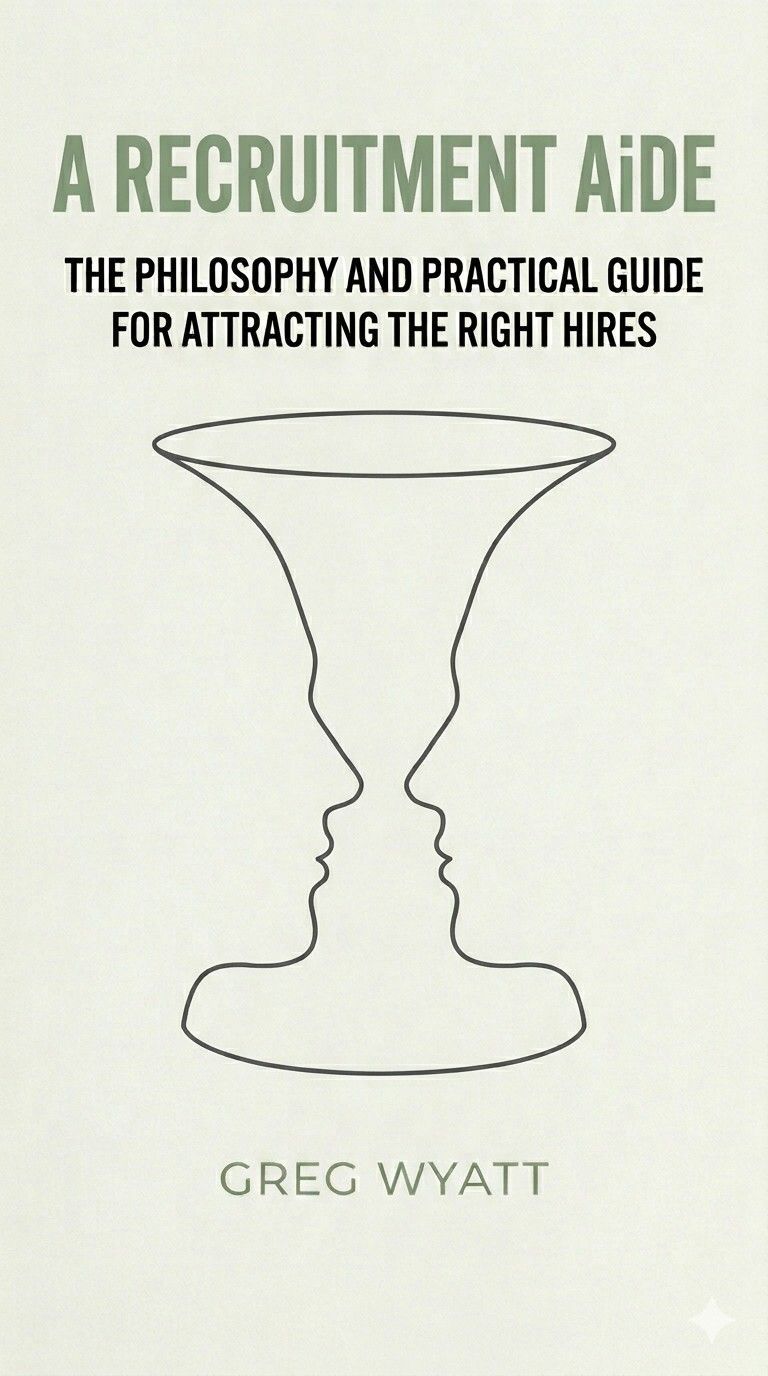
So What? A Recruitment AiDE, pt 1
An introduction
Welcome to the first edition of A-nt—I Recruitment.
If you stuck around with me on substack over the past three years, some of this will be familiar. I’ll be curating my most popular series of
writing, for a new audience on LinkedIn.
I've stopped writing on that substack for now, but feedback is that it's engaging and helpful, which I hope you find the case too.
What can you expect? These are series that I've already published - around a year's worth of content.
- The AiDE framework for attracting ideal hires
- Innovation from iteration – how other industries can improve recruitment
- No problem – recruitment problems that drive opportunity
- Recruitment reflected – how candidate experience and resentment can improve our work
- Negotiate this – how 'Never Split the Difference' by Chris Voss applies to hiring
- The art of recruitment – Sun Tzu because of Ross, and because humans don't change
- Selected others
These were tremendous fun to write and, through sharpening my ideas, have made me a better recruiter. I’ve also seen recruiters I respect adopt my ideas, such as “reciprocate the care your candidates take” as a fair balance in a volume marketplace.
Why the tremendously stylised name?
You’ll see the capitalised AI, straddling nt, spelling out anti. But this isn’t about hating AI and recruitment – I love the opportunity both have. We all love an em-dash too.
It’s because the opposites in recruitment aren’t what we do, it’s why we do it.
Are you driven by systemised, scalable, profitable recruitment?
Or do you always want to put people first, with a candidate-centric approaches that delivers long-term outcomes?
I’d wager you can do the first without the second, and the second without the first.
The real win is when you nail the philosophy of human first recruitment, and enable it through technology.
It needs to prioritise on the needs of ideal candidates, so that everyone benefits. Instead of the typical employer first approach.
And so here we are with the first article, and part of the series on my AiDE (Attention ikigai Definition Experience) framework.
It’s called:
So What?
A couple of years ago, I ran an experiment on LinkedIn to see what meaning readers would take from this post:
“Today I ran 5km in 33 minutes. I am 42, 6 ft 2, 200lb and have a resting heart rate of 50bpm.
What does this say about me?”
The plan was to analyse the commentary, look for themes, and use these for further content on advertising, CVs and what people take from social media.
Across the 100 or so commentators, only one person rightly said “nothing at all”.
While the other commentators said anything from “don’t beat yourself up” to “well done” to “that resting heart rate indicates a high level of fitness” and questioned the running time.
One kind gentleman took it upon himself to describe his fitness journey and how I should be proud that I’d started running in my 40s.
He also took offence when I explained the rationale for the post, in a subsequent one.
The reason for the wildly different responses is that this post lacks context.
What kind of background can you imagine that would have given relevant substance to this post?
If all the post had said was that first line, a rational response would be:
"So what?”
It’s a post rife with ambiguity, where the only meaning is that which is taken from it.
And 99 people found their own meaning.
I did inadvertently lie though.
My 6 ft 2 height was confirmed by a doctor in 2008.
I went to the hospital a couple of weeks ago, and now I’m a smidge under 6 ft 1!
The gravity of the situation hasn’t passed me by, nor has the nature of subjective truth.
Does it matter more what we write, or more how others read those words?
Recruitment is an industry where ambiguity, clichés and clever-speak hide meaning from its consumers.
Take this classic first line in an advert:
“My favourite client is a market-leading employer of choice going through rapid growth.”
I think it’s only natural for an recruiter who knows no different to write this and both believe it and believe that readers will believe it.
What follows will typically be something like -
“Their friendly, innovative and progressive team is looking for a Retro encabulator designer with these responsibilities: <insert anonymised job description>”
Before the grand finale of “We act as an employment agency, don’t do isms and if you haven’t heard from us in one week, you are dead to us”.
It’s a natural thought process, and symptomatic of a transactional recruitment system.
Without a full brief, without insight, without training or an inclination to learn copywriting, and with a need to advertise, how can you do any different?
If it were the only advert to say exactly this, it wouldn’t necessarily be a problem.
Except that adverts commonly do read like this, making it pointless to actually read their content. You might as well just go off the job title, salary and location.
And if you do bore yourself dense reading them, can you come away with any response but “so what?”.
So – so what?
As well as a natural reaction to piffle, it’s a handy editorial tool, used by anyone that wants to strip away ambiguity and show both context and meaning.
It’s much like 5Y, an iterative question that lets you peel back onion layers to find meaning.
So what, “market-leading” – what does that look like in practice?
Why are they growing rapidly – is it because they’re full of hot air?
What does innovative and progressive look like in their team? What is friendly?
Ask ‘So what?’ of your content and you’ll give better meaning.
Better yet, ask others what they make of your content.
Does your advert actually have any meaning?
Can people tell what your job is from your job description?
Do your interview confirmations regularly get questions asked of them?
Back to that post at the top. I did follow up with some good posts (IMO) showing the problem of ambiguous meaning. Here’s one of them from last week:
“What your CV says: ▪ 2021-2022, Sales Manager - achieved £500k in sales
What a reader might assume: ▪ sacked after 12 months falling 50% short of a £1m account management target
What you meant: ▪ achieved 125% against a £400k new business sales target, completing a 12-month maternity contract
Ask 'So What?' of the responsibilities on your CV. Give better meaning to your words, so that we don't have to find our own.
Unless you were indeed sacked, in which case ambiguity may work in your favour.
Agree, thoughts?”
I don’t think it’s much of a leap to find wildly different meanings from the ambiguous words you may find you use.
Ask So What, and do yourself a favour.
Thanks for reading.
Regards,
Greg