Map the Market. Jobseeker Basics XVIII

Greg Wyatt • February 23, 2026

What follows is Chapter 21 in A Career Breakdown Kit (2026).


It's a good example of how a job search is an inverted recruitment exercise, but also how the same principles from recruitment can be applied in a job search.


Market mapping is one of the first steps of a search process in what is often called headhunting. Here though, instead of an exercise that helps find a person for a job, you help find a job for you.


This can be in one chunk, at the outset, and iteratively, as you learn more information.


It's a great example of how LinkedIn can be used as a data repository, given the vast majority of professionals are present here. And if they are present here, the insight that is their careers is too, allowing you to identify potential viable employers, who works there, and therefore where else they may have worked, with further potential hiring managers. The snake that eats its own tail.


Try doing the iterative work above, every time you come across someone new, whether in an application or in networking.


You can use this to build out your network, identify companies to contact proactively.

Simon Ward and I will talk more on this in our LinkedIn Live on Tuesday February 24th at 1pm GMT. You can join us, and view the full recording afterwards, here:


Is The Nature Of Networking Changing for Job Hunters?


If you happen to read this as a hiring authority, market mapping is one of the invisible processes in a structured search. It can often take me 80 to 100 hours to fully map a role for potential viable candidates, given I try to find non-traditional candidates as well as those that are easier to find through sourcing.


21 - Map the market


Market mapping is a common activity in executive search. Why wouldn’t you adopt the same approach in your inverse of a recruitment exercise?


The idea is to fully understand your market, so that you are better able to navigate it.


This is a summary chapter because market mapping is both a strategic and a tactical exercise.


I’ll cover some of the How of mapping in Part Three.


There are three ways in which to map the market.


The vacancies you are qualified for


This is about determining which vacancies you should focus your attention on.


In which domains does your capability directly apply?


This could be context related, if your expertise is in start-ups, growth, downsizing or other contexts.


It could be industry related - your process manufacturing expertise might directly apply in food, plastics or pharmaceuticals.


It could be job related, with the right applicable skills.


Establish where there is a market for you, and if what you offer is needed by that market.


Advice on the transferable skills trap (p55) and whether you are qualified (p178) to apply will help.


The geography of your job search


Where are all the employers and vacancies that you can sustainably commute to?


A geographical map can help you target opportunities by region.


What resources are available to help you with this map?


Searching online for local business parks, even driving around them, can give a list of viable companies to contact. Directories and membership hubs. Local newspapers, social media stories.


If you see a company you like the look of, say from an advert, search on their local post code. Who else might be there?


The chapter on doorknocking (p241) has more ideas.


The people of your network


Every time you come across someone you might build a relationship with, connect with them on LinkedIn.


Then check out their career history. Who else have they worked with? Where else have they worked?


This works for peers, hiring managers, and recruiters - a headhunter in one company may well have worked in a similar domain in a previous one.


Is there anyone at these previous companies you should introduce yourself to? What about their listed vacancies?


Building out a map of relevant recruiters to develop relationships with (if they answer the phone) can lead to vacancies.


Treat it as an iterative exercise.


Check out the chapter on networking (p236).


This map isn’t just about potential opportunity. It’s also about information that might be helpful now and in future. This might be for job leads. It might be industry insight you can share through content. It may even be topics for conversation in interviews or with peers.


Make sure you track it in the right way, whether through Notion, Excel or other resources you have available.


With any information, check it is accurate, then prune appropriately.


Prioritise on degrees of separation (closest first) and context fit (where what you need is most closely aligned with what you offer).


By Greg Wyatt February 19, 2026
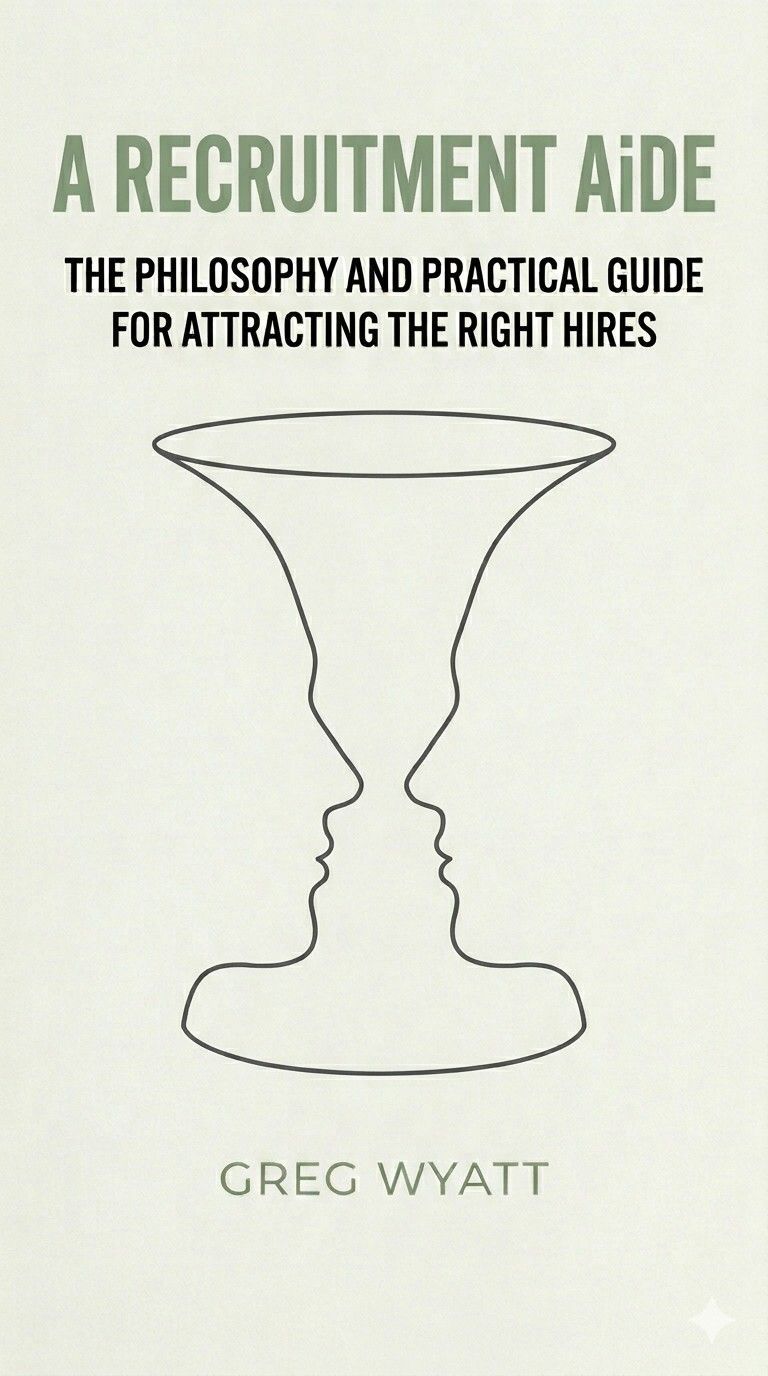
I find myself questioning whether I effectively use AiDE, and whether it's effective enough every time I recruit. As an external partner I work low volume, which allows time to do things 'right'. However, when I take on fractional in-house work, I still deploy the same framework, even at mid volume (my highest volume was 55 vacancies in six months). Because it's scalable and can be applied across a whole recruitment system. I wouldn't recommend it to a high volume, high churn environment, though I expect they aren't reading these newsletters. It isn't just about advertising. A current vacancy is at final interview today. I ran an 'appropriate multichannel' campaign, including public advertising, networking & referrals, 'headhunting' (sourcing across LinkedIn and CV databases). My advert was a consequence of my consultations, as was the six page candidate pack provided to viable applicants. My narrow then wide sourcing strategy was a consequence of the same consultation. My written and spoken outreach was also a consequence of this. That I shared the advert and candidate pack proactively, was in part why I had a 100% response rate to my six inmails (it's a niche role in a low population area). What was also interesting was that a number of the applicants described themselves as passive, and there was a significant overlap between the 56 and the sourced longlist. I noted that one of the final interview sourced candidates had viewed the public advert after our initial conversations. I find advertising can be effective with passive candidates, because they can browse without commitment. You'll never know they were there if they don't get in touch, and they aren't going to be interested in a cookie cutter peacock advert. But that gap is a hard one to breach if all you know is "we're a market leading employer of choice". Because we rely on the evidence of what's in front of us. This is the final AiDE piece. I plan to publish this as a short paperback, given I think it stands alone as an approach that can improve your recruitment. Next week I start "Innovation from Iteration" which includes an article on why the Gemba (value from the shop floor) is valuable for recruitment. Where it relates here is that my work with job seekers, and what turns them off from enquiring to adverts, has been so helpful in finding the blind spots our habits miss. While the next series is separate, and was mainly written before AiDE, both show the modularity of recruitment and how you can experiment iteratively, layering on good foundations in a way that best works for you. As I've said before, you can see pretty much all of me through these pieces, which may help you decide whether we should ever do business together. This final piece is about how negative descriptors can attract great people. In the example above, one of the lines I lead with is "this won't be for you if you thrive in a structured, corporate environment." Both because it's true, and because it speaks to frustrations viable candidates may have. Of course I also talk about how they can make a bigger splash in a smaller pond, if they can adapt to a smaller company setting. Pushing and pulling are key tools in the AiDE framework. Negative Space June 2023 “This isn’t just any typical food manufacturing company, with an as-is workforce that only requires handholding and firefighting.” A bit of context: HR in the East of England is fragmented, with many senior HR practitioners being more of the old-school personnel approach than commercially focused. And others adopt the People title with no rhyme or reason. A common reason for commercial HR vacancies rejecting candidates who have identical CVs to successful candidates is that line above. It resonates with many commercial HR practitioners that have interviewed either as an employer or candidate. Firefighting here means the high volume of employee relations common to food manufacturing. No time to do the proactive stuff. I should point out this was a confidentially advertised vacancy. Were it branded or directly advertised, you’d need to think about how this kind of description is perceived, in case you’re seen to criticise your ‘competitors’. When I ran it on LinkedIn, there were 32 applicants, 14 of whom were auto-rejected by the killer question ‘do you have full right to work in the UK’. 10 were suitable enough to call. 2 of these were submitted to the employer, alongside 3 found through other means. 1 of them got the job. In total, I spoke to around 40 candidates before presenting this shortlist. “That line really struck a chord with me, and it’s so true of some of the companies I interviewed with last time”, said the candidate that went on to get the job. She'd also seen their original advert and not applied, because it seemed exactly the same as her current one. She wasn’t the only person to comment so. Disappointingly, not one person spotted the M&S allusion. By highlighting what it isn’t, this line draws attention to what it is: The negative space of a vacancy. It’s actually pretty simple to find this kind of example for any common skill vacancy - I include a niche HR role in this category. “What reasons have you had for declining candidates, in terms of skill sets, context or attitudes?” “Why wouldn’t someone work out in this role?” “Why did it go wrong last time?” The answer’s with the hiring manager. If it’s a role for which there are archetypes for success and failure, you can set the scene while speaking to the ikigai and experiences of your readers. We should be mindful of bias of course: “This isn’t a company with a diverse workforce or where people stay longer than a year” might be an accurate counterpoint to concerns about culture fit and institutionalisation, but perhaps not something you want to advertise. “You’ll hate it here if you’re a West Ham fan.” “If you enjoy the machinations of structured corporate life, this won’t be for you.” It’s an approach that works for many reasons: It sets the scene with texture and candour It appeals to the experiences of candidates and builds trust It tells them they aren’t going to waste their time by going for the wrong job It shows you know the truth of the vacancy, from unexpected angles For readers that enjoy “a steady reactive workload where they can support line managers through disciplinaries and grievances,” they’ll get a sense they aren’t an ideal candidate, confirmed by the rest of the advert. Nothing wrong with what they do, of course, it’s just a different type of HR. It’s an ‘essential requirement’ in disguise that helps readers make the right decision while giving an implicit and constructive reason for saying no It’s unusual enough to be a pattern interrupt that encourages credibility and to focus on the rest of the advert If relevant, I’ll include ‘negative space’ in my adverts, whether above-the-line or below-the-line. If you were wondering about the picture, which is a style you are likely familiar with – it’s Rubin’s Vase, an optical illusion whereby two faces are created from the negative space of the vase. Thanks for reading. Regards, Greg
By Greg Wyatt February 16, 2026
In tomorrow's LinkedIn Live, Simon Ward and I will debate the merits of customising applications. Simon is mainly on the side of customisation, whereas I feel it's often relied on as a crutch that detracts from more effective action. I'm not against it by any means, yet it falls much lower on my priority list than you might think. You can join us tomorrow at 1pm GMT, by clicking on this link: https://www.linkedin.com/events/shouldajobhuntertailortheircvfo7427656161476415488/theater/ You can generally see my views on customisation in three chapters of A Career Breakdown Kit . I've shared two of them in this newsletter already: Hierarchy of Pain , which explains why the real essential requirements of a vacancy aren't always articulated or even defined, in which case customisation can actually work against you. De Facto Automated Rejection and You , in which I explain why the ATS isn't the real problem, and what you should consider instead. Given customisation and 'ATS Compliance' go hand in hand, this is a must read. The third chapter is shared below and answers the question more directly. But if it's all far too TL;DR, then you should only customise your application if you answer yes to these questions: 1/ Is my core CV good enough? Good enough is your minimum acceptable level - not the goal - and I'm sorry to say the vast majority of CVs do not meet this threshold. 2/ Do I know the hierarchy of decision making in the hiring process, and what each stakeholder needs from the application? 3/ Does the advert speak to me personally? If it's a generic document, you can bet your customisation will look precisely the same as every other person taking the good advice to customise their application. 4/ Could the employer or agency have further vacancies, now or in future, that I am better suited to? 5/ Does my customised CV resemble my LinkedIn closely enough that it doesn't appear to lie? 6/ Am I articulating applicable skills, direct qualifications and relevant experience in the language of the vacancy? 7/ Does the time taken to customise outweigh the speed needed to apply? 8/ Am I 100% focused on the jobs that best meet my strengths? 9/ Is this a better use of my time than the harder activity I've been putting off? 10/ When applying through a job board, is this CV optimised to be findable for my ideal role through their CV database? I'm sure there are more, but these are a good start. The three chapters explain why you should ask these questions first, so you can make sure your strategy works for you. And these are the basis for my side of the discussion tomorrow. 34 - Should I customise my CV? It depends. Am I qualified? Strip away bad behaviour, laziness and discrimination, and ask any hiring manager what they want from an application. I’d wager the most common answer will be - ‘Qualified candidates’ Qualified goes beyond capability. Can we identify any insurmountable nos? This might be experience, qualifications, assumption of salary level or commutability, availability, or a lack of work permit. Often it comes down to assumption. Fair or not, it’s their assumption to make. All we can do is show how we qualify. Ask these same hiring managers what proportion of applications aren’t qualified enough, and the answer will be anywhere between 75% and 100%. Many of these will be wing and a prayer or automated applications. White noise that detracts from qualified candidates. If you truly are a best-fit candidate for a vacancy, how would you feel if unqualified applications took attention away from you? In a world where job seekers are often told to ‘shoot your shot’, is it possible that you’ve been an unqualified candidate on occasion? When looking at any advert, ask yourself - Am I qualified to do this job? If yes, ‘How will my application demonstrate that I am qualified?’ This informs whether and how you should customise a CV. Most jobs are learnable, using transferable skills. If everyone can learn and has similar transferable skills, neither of these is a remarkable quality. They don’t stand out and they don’t inherently qualify you for a vacancy. I expect that a significant proportion of what are considered to be unqualified candidates could ‘do that job’ with sufficient support. It’s just that the expectation is other applicants can do the job better or achieve sufficiency sooner. This may be perceptual and unfair. It is how many people make decisions when recruiting. Instead, the onus has to be on the applicability of what we offer. What’s in it for them? Can you show how each facet of your candidacy applies in the context of the vacancy? If you can’t, the decision is likely to be against you in a competitive market. If you strongly believe you are qualified for points you are always rejected for, you have to articulate why. This may be for as simple a reason as living 70 miles from their office. They assume it’s too far and say no. You’ve been commuting 75 miles for 10 years, and you know you are qualified. Say so. Same with salary. They judge you were probably on £70k and their budget is £60k max - it’s not going to work. You’ve done the maths. It’s a great job, the salary is fair, and it’s affordable. Say so. Or those career gaps. ‘This person’s unemployable - no work for three years!’ ‘When I was made redundant, I had the opportunity to support my ailing mother. She passed away in March, and I’m ready to work.’ Say so (and I’m sorry for your loss). When we talk about being qualified, it’s often more about the skills and capability required to do a job. If you know you can do the job, show how in your application. This should be the core part of your proposition in words a reader will accept to help us make the right decision. If you can’t achieve this in your application, you may not be seen to be qualified. ‘Core part’ is important, because you may be someone who has an excellent track record, and a small part of your expertise relates to the core of a vacancy. You may be able to show this in your application. However, if you are competing against candidates whose main expertise is the core of the vacancy, you may be perceived generally as a weaker candidate. An exception might be if you can demonstrate specifically how your wider experience solves problems the vacancy will have. How can you glean that from a generic advert? If you aren’t getting any return from customising CVs, it’s because you aren’t seen to be a qualified candidate (if your CV is even seen at all). And if you can’t provide suitable and sufficient evidence that you are a qualified candidate, you should save your time by not applying. Whenever I talk to job seekers frustrated by spending hours on customising CVs only to be knocked back instantly, I’m equally frustrated to say they probably never had a chance with those applications. Strip those applications away and focus on the ones you can show qualified candidacy for quickly. You’ll save a lot of time and frustration and you’ll IMPROVE your odds, by giving you more time to focus on what matters - more suitable vacancies and different job search activities. You’ll also improve the odds for more qualified candidates. Customise to beat the ATS! Okay, if you’re worried about beating the bots - reread the ATS chapters (p29). Worry more about being human optimised with a ‘good enough’ CV - it will be implicitly ATS compliant because of what an ATS is. Yes, solutions are changing all the time, yet as ‘AI’ evolves on recruitment platforms, it will emulate how humans parse documentation. Appropriate human optimisation is still key, our warts and all. Not keyword bombing and ‘93% ATS compliant’ piffle. Good enough The argument that you should customise your CV against every application to maximise your odds seems to make sense. Yet, it neglects one key principle. That your starting CV is good enough. In many applications I see, they are not. I don’t mean that they haven’t been customised, I mean that they aren’t fit for purpose. And if that’s the case with your CV, customising only covers over the cracks in a weak document. CVs in general are weak in specificity, context, applicable skills and readability. Because people in good times often get by on weak documentation. Jobs are aplenty, suitable candidates competed for - you can succeed with less. In bad times, good enough has to be a minimum, and most fall short. I had a debate with a career coach recently who challenged me that ‘good enough’ will never get you a job - why would you always want to be sixth place? Yet if CVs aren’t good enough to start with, there’s little point in chasing perfect - the most subjective of principles. If you don’t get past the first sift, you won’t even get to sixth place. Get the objective principles right and build from there. Besides, everyone has an opinion on what good looks like in CVs. Perfect for one may be rubbish for another. Quite the stinger when you’ve paid for perfection. Good enough is about reaching an objectively good CV-state for your context, which depends on all those factors unique to you - your skills and candidacy, the state of your market, the volume of competition and vacancies. Good enough shows you in your best light, highlighting your candidacy for the role you are most suited for. You can’t be all things to all people - good marketing is about leaning into what makes you, you. Get your CV right, and it’s the basis for non-application activities: Your LinkedIn profile (given it should be consistent with your applications) A document you share in networking (there’s no point customising here) A CV that may be found on CV databases (read Better Use of Job Boards - p211) A CV you’ve used for an application you were rejected for, then logged onto an ATS which is visible to the hiring team for more suited vacancies they may not even advertise The basis of how you describe yourself in personal branding, elevator pitches, doorknocking and any other commercial-type activity that can put you closer to a job A CV isn’t just an application tool, it’s the anchor of your professional identity. It isn’t just an outbound document, it can attract inbound interest. And if you get it good enough, any customisation should be minimal, allowing you to apply for suited vacancies more quickly. Quality of information Let’s face it, most job adverts and job descriptions aren’t fit for purpose either. Your experience of generic, misrepresentative job adverts mirrors how recruiters experience generic, misrepresentative CVs. Those carefully written adverts that appear to speak to you directly… well those are good enough adverts to spend time on. For the rest, would it make much difference if you relied solely on the job title, working arrangements and salary? Perhaps industry and product type, too. ‘Here at Bircham Wyatt Recruitment, we are a market-leading progressive innovator of fast-paced all-level communication.’ A lot of words which say nothing at all. And because everyone uses them, they lose meaning - as with transferable skills. Strip all the twaddle away, and if those top-level points are adequate, I expect you’ll go straight to Essential Requirements to see if you are qualified. The problem with generic adverts is that these Essential Requirements may also lack Essential Specificity. What’s misrepresentative? What’s missing? What are they really looking for? This is often hidden pain that is key to unlocking a vacancy – something I write about in more depth, in the next chapter. If you aren’t certain on these points, what are you customising against? Could it be you accidentally edit out what makes you most suited to a vacancy, if what they leave unsaid is the most important piece? Sometimes this is down to carelessness by the employer - sometimes it’s deliberate: I once placed an HR Manager at a ‘rapidly growing’ company. They didn’t tell me or her that the thing they needed most was her mass-redundancy experience, which was what she was tasked to do on day one. The truth was the opposite of their job description. And sometimes different stages of the hiring process have different priorities, which may never have been articulated in the advert: Administrator, Recruiter, Line Manager, Head of Department, Director... A messed-up perfect storm If you’ve made it this far, you’ve probably been looking for work for a while, in a competitive marketplace with too many qualified candidates, far too many applications, and too few viable vacancies. Plus, technology that encourages speed and volume. And under-resourced, over-worked hiring teams, many of whom don’t do hiring as a day job. Have you ever spent an hour customising a CV only to learn you were application number 232? Without knowing they’d closed applications at 200. And you received an instant rejection? Sometimes, it may be a question of speed over quality. How do you find the right balance? Reciprocity in action For advertising, the balance is simple. Invest as much time in your application as their effort in the advert. For a transactional generic advert - apply transactionally, diarise a follow-up, move on. Keep these in a transactional fire-and-forget pile. For the adverts that speak to you personally or take time and care to accurately articulate what the role is and what it offers you, reciprocate this effort in your application. Keep these in a non-transactional pile. Measure your return separately. You’ll find a higher hit rate in the second, with the virtuous circle of your added investment. While the lower hit rate of the first is mirrored by not needing to have put so much of yourself into it. What about AI? There are many wonderful AI tools available, and if you want to take the time out of customising CVs, automating seems a great opportunity. What exactly are they customising against? Because the quality of information you can convey is based on situational insight, it seems to me that AI can only tweak terminology or regurgitate what others have already written. If everyone uses AI in this way, the output is generic resulting in same-same messages and CVs at scale. This is what I’m hearing from people who are recruiting - reams of identical looking applications that lack punch. It doesn’t help; it works against you. For ideation, research, analysis, it’s an effective tool. Ask it which areas of a job description you might focus on selling your experience against. For applying at scale, for now, it’s part of the noise. Should I customise my CV and how? It depends. If your CV is already ‘good enough’, it shouldn’t take too much time to show how you meet the essential requirements of an advert. If an advert sings to you and you feel inspired to put your best foot forward, you should (maybe check it’s still live first). Use relevant impact based achievements. ‘I did x by y resulting in z’ Show relevant context - if your last employer was a context fit, show how. E.g. Rapidly growing scale-up, 50 to 250 in one year, t/o £24m. Or 500 staff, manufacturing of precision components for aerospace, significant downsizing programme Align your language to theirs - they say PDCA, you said CI. They say S&OP, you said integrated business planning. Don’t fabricate Remember - what’s in it for them? How will you solve their problems or help them reach their desired outcomes? For other situations, I’d question whether the marginal gain of customisation should be set aside for what may be the maximal gain of what you don’t want to do: Networking, doorknocking, personal branding, and all those other inbound and outbound activities that might get you closer to a job.